


Butcher School · Beef
How to Cook a 1-Inch Ribeye
Cast iron or grill, exact minutes, exact temps — the method we’ve given away over the counter in Bemidji since 1940.
Thickness is the whole game.
Cook time has almost nothing to do with weight and everything to do with thickness — heat moves inward from the surface. Too thin and the center overshoots before the crust forms. Too thick and you need an oven finish. One inch is the sweet spot where a screaming pan and eight patient minutes give you a steakhouse result.
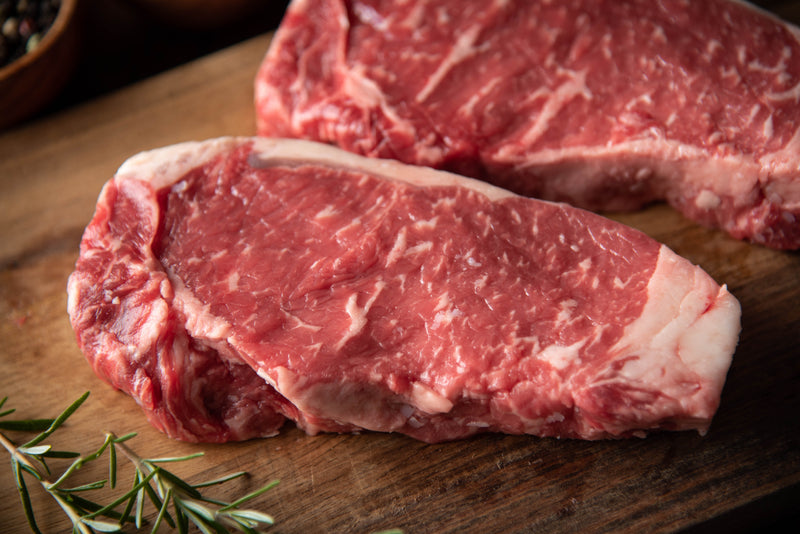
That’s why every steak in our fresh meat counter is cut a standard 1 inch thick — a Stittsworth ribeye is a 12 oz steak at a flat $22.99 — one set price, no scale surprises — cut fresh when you order. Same steak, same time, same result. Every time.
The butcher’s method: Cast iron, five steps.
01 — Salt early, dry completely
Pat the ribeye bone dry with paper towels, salt hard on both sides, and give it 30–40 minutes on the counter. A dry, room-temp steak sears. A cold, wet one steams gray.
02 — Heat cast iron past shimmering
High heat until a water drop skitters and vanishes. Thin film of avocado or canola oil — butter this early just burns.
03 — Sear 3–4 minutes, flip once
Lay it down away from you and leave it alone. No pressing, no peeking. Flip once at 3–4 minutes, sear the other side the same, and stand the fat cap on edge for 30 seconds to render.
04 — Butter baste the last 2 minutes
Two tablespoons of butter, a crushed garlic clove, a sprig of thyme. Tilt the pan, spoon the foam over the steak nonstop. This is where the steakhouse crust comes from.
05 — Pull at 125°F. Rest 8 minutes.
Thermometer in the side, to the center. 125°F for medium-rare — carryover finishes it to about 130–135°F. Rest on a rack, not wrapped, 8 minutes. Then slice against the grain.
On the grill instead?
Same prep, two zones. Sear over direct high heat 4–5 minutes per side with the lid open, then slide to the cool side, lid down, until the thermometer reads 125°F. Flare-ups mean rendering fat — move the steak, don’t fight the fire.
Charcoal beats gas on flavor; a chunk of oak or hickory beats both. If you’re smoking low-and-slow first (the reverse sear), run 225°F to an internal of 110°F, then sear 60 seconds a side over the hottest part of the grill.
Pull temps, not guesswork.
Pull at the first number — carryover heat while resting takes it to the second.
| Doneness | Pull at | After rest | What you get |
|---|---|---|---|
| Rare | 120°F | 125°F | Cool red center |
| Medium-Rare | 125°F | 130–135°F | Warm red center — the butcher pick |
| Medium | 135°F | 140–145°F | Pink throughout |
| Medium-Well | 145°F | 150–155°F | Slight pink |
| Well | 155°F | 160°F+ | No pink (we tried to stop you) |
How long do you cook a 1-inch ribeye?
In a ripping-hot cast-iron pan: 3–4 minutes per side for medium-rare, pulling at 125°F internal. On a hot grill: 4–5 minutes per side over direct heat. Thickness matters more than weight — that’s why we cut every ribeye a standard 1 inch.
What temperature do you pull a ribeye for medium-rare?
Pull at 125°F internal. Carryover cooking raises it to about 130–135°F while resting, which is a true medium-rare. Pulling AT 135°F gives you medium by the time it hits the plate.
Cast iron or grill — which is better for ribeye?
Cast iron gives the harder, more even crust because the whole surface contacts the metal — it’s what steakhouses use. The grill gives you smoke flavor and rendered-fat flare. Both work at 1-inch thickness; below that, only cast iron saves you.
Should you rest a ribeye after cooking?
Yes — 8 minutes minimum for a 1-inch steak, on a rack, not sealed in foil. Slicing early pours the juice onto the cutting board. Resting lets the muscle fibers relax and reabsorb it.
Why does steak thickness matter more than weight?
Cook time is driven almost entirely by thickness — heat travels inward from the surface. A thin, heavy steak overcooks before it crusts; a thick, light one crusts before the center moves. That’s why Stittsworth cuts every counter steak a standard 1 inch: same time, same result, every time.
The method only works on real meat.
Hand-cut 1-inch ribeyes from our Bemidji counter — a 12 oz steak at a flat $22.99, one set price, cut fresh when you order. Pickup at the shop or shipped cold to your door.
Start With the Right Steak
Fresh from the Bemidji counter
Why Our Smoked Meats Taste Better
- Five generations
- No Fillers. No Shortcuts.
- Ships frozen from Bemidji. When we ship it, you eat it.